
2021
Hathi Chair
Convertible Furniture
Ergonimics
The Idea
While working from home, I found myself constantly switching between wanting an armrest and wanting it out of the way.
The inspiration for the Hathi chair is complex. Initially I study Japanese furniture and started to ideated based on the keywords and visual features I grasped from the study. Throughout this lockdown, working from home, I have experienced many situations where an armrest is an absolute necessity, however, soon a special situation would arise where the armrest becomes an obstruction, my goal was to eliminate this problem while I ideated based on the study of Japanese wood works. Thus, Hathi Chair was born.
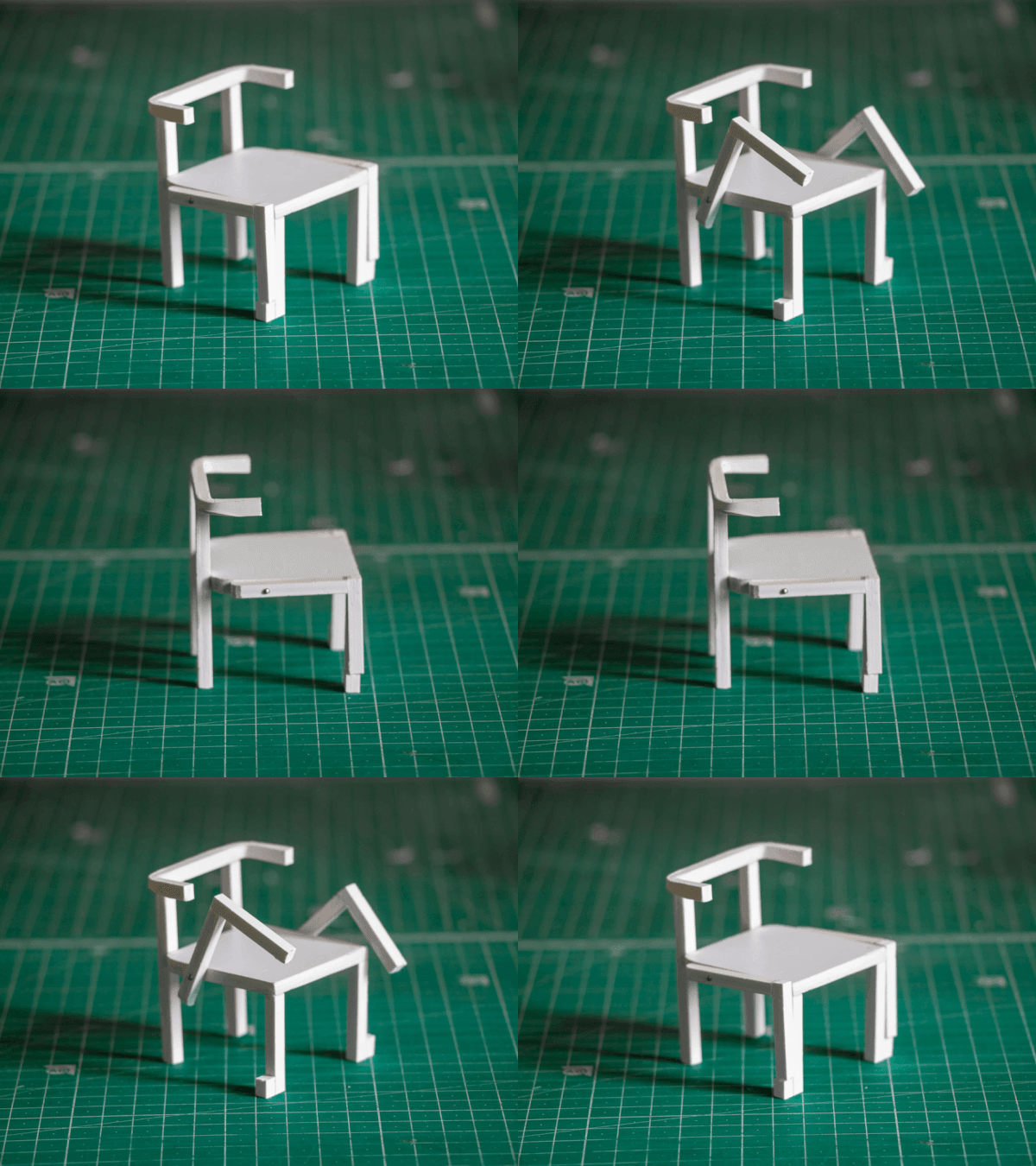
In Hindi Hathi means elephant. Hathi Chair shares it's characteristics with an elephant- swinging of the armrest like a trunk, bold form, thick volume. Functionally, the chair's ability to switch between chair-with-armrest and a one without, finds it's place in a work-from-home scenario where this feature will be specially helpful.
Behance Link: https://www.behance.net/gallery/123144221/Hathi-Chair-2021


Ideation
Exploring the movement
The central challenge was not the chair itself, but the movement of the armrest.
I explored different ways in which the armrest could move, fold and disappear without compromising the character of the chair. Sketches became increasingly focused on the relationship between the back, seat and moving arm.
The idea eventually settled into a simple swinging movement, allowing the chair to transition between two states:
with an armrest → without an armrest.
The movement also gave the chair its distinctive character.

Process
Proof of Concept
Once the movement was established, I moved quickly into physical prototyping.
The first prototypes were deliberately rough. Their purpose was not to look finished, but to answer basic questions:
Does the movement work?
Does the armrest stay in position?
Does the form remain stable?
Does the mechanism make sense physically?
This stage helped separate interesting ideas from ideas that could actually become a chair.

Process
Iterative prototyping
With the basic mechanism working, I began iterating on the proportions and relationship between the components.
The process was intentionally physical. Rather than trying to resolve everything through drawings, I used prototypes to understand the chair through my hands and body.


Process
Refining the chosen form
After several iterations, the overall form began to settle.
The chair needed to feel substantial enough to communicate its bold character, while remaining visually simple. The moving armrest became an integral part of the silhouette rather than an additional mechanism attached to the chair.
At this point, the design was refined around the chosen proportions and construction logic.

Process
From concept to wood
The final stage was about translating the developed form into a wooden prototype. The prototype was produced at 1:4 scale, allowing the proportions, construction and character of the chair to be studied as a complete object.
The final form measures 14.5 × 13.5 × 18.5 cm at 1:4 scale, corresponding to the intended full-size chair dimensions of 20 × 18.5 × 26 inches.
The result is a chair that changes its relationship with the user depending on the situation, without looking like a piece of transformable furniture.

Process
From concept to wood
The final stage was about translating the developed form into a wooden prototype. The prototype was produced at 1:4 scale, allowing the proportions, construction and character of the chair to be studied as a complete object.
The final form measures 14.5 × 13.5 × 18.5 cm at 1:4 scale, corresponding to the intended full-size chair dimensions of 20 × 18.5 × 26 inches.
The result is a chair that changes its relationship with the user depending on the situation, without looking like a piece of transformable furniture.


Hathi Chair
The idea behind the name
The name came after the form began to take shape.
Hathi, meaning elephant in Hindi, describes both the visual character and the movement of the chair. The chair has a thick, bold volume, while its swinging armrest behaves almost like an elephant's trunk.
What began as a functional problem therefore became the defining visual gesture of the chair.
