
2022
HawkEye (Modular SL)
A modular handheld ophthalmic equipment. Used during a comprehensive eye examination to screen for most common eye diseases.
A modular handheld ophthalmic equipment. Used during a comprehensive eye examination to screen for most common eye diseases.
Hi, I am Quinn® I’m a passionate and innovative 3D designer with over a decade of experience in the field. My journey began with a fascination.
Hi, I am Rosa® I’m a passionate and innovative 3D designer with over a decade of experience in the field. My journey began with a fascination.
Human Machine Interface
Eye Care Equipment
Concept
“We’ve always wanted to go to the patient. HawkEye lets us carry the clinic in our hand.”
— Optometrist, LVPEI
Over 75% of visual impairment is avoidable. Yet, millions lack access to quality eye care due to bulky equipment, geographical barriers, and high costs. HawkEye is a phone-integrated, modular ophthalmic screening device that delivers slit-lamp imaging, tonometry, fundus capture, and corneal topography — in a compact, affordable form. Designed with clinicians, tested with real patients, and validated under IRB trials, HawkEye is a rare confluence of medical, industrial, and human-centered design.
A human-centered redesign of ophthalmic diagnostics — making comprehensive eye exams accessible, mobile, and modular.


Brief
Redesigning Eye Care for All: From Clinics to the Community
HawkEye is a modular, smartphone-powered ophthalmic screening device that condenses the functionality of four essential eye exam tools into one portable system. Designed for LVPEI’s mobile and rural initiatives, the device addresses India’s pressing need for affordable, scalable vision diagnostics.
“This wasn’t just about design. It was about dignity, access, and trust — where patients are.”
— Harshavardhan M V

Why Eye Health
The Case for Vision Access
While advanced hospitals serve the affluent, the rural population is left behind. Traditional ophthalmic tools are bulky, stationary, and prohibitively expensive — widening the care gap. LVPEI’s Operation Suitcase project sought a leap: affordable, field-ready diagnostics in one compact device.
“Most blindness isn’t fate — it’s access.”
Lack of access due to high cost and geography.
India has 15 million visually impaired; 75% of blindness is avoidable.
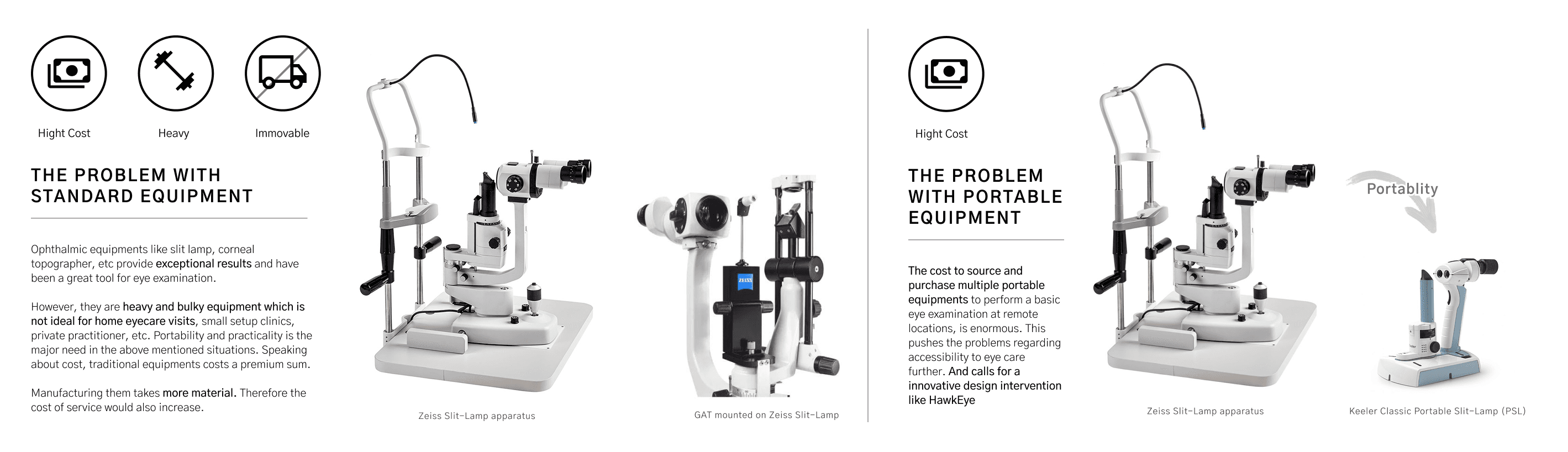
Existing equipment is bulky, non-portable, expensive.

Problem
The Cost of Vision: Bulky Machines, Invisible Barriers
From slit lamps to tonometers, every essential device for eye care is large, costly, and built for clinics. Even when portable options exist, their pricing defeats accessibility. For community clinics, home visits, or low-budget hospitals, these tools are simply not viable.
“Even the portable devices were out of reach — we needed a complete rethink.”
— Optometrist Rahul Negi
Concept
One Handle. Many Eyes. The Modular Magic of HawkEye
“Modularity was the answer. If we could swap lenses, why not diagnostic tools?”
HawkEye compresses four critical diagnostic tools into one system. Using magnets, custom grips, and intelligent interfaces, modules can be seamlessly swapped while the smartphone captures diagnostic imagery. It's not just portable — it’s scalable, teachable, and ready for home care.
In the given timeline, as a lone designer, I could complete only 3 states of HawkEye. Fundus imager and Corneal topography are still WIP.


These three images are the three modes of HawkEye. Using these three modes, we are able to perform 4 types of screening tests.
Process
Research, Sketch, Iterate — Then Repeat
Over 6 months, I lived and breathed this process — sketching, prototyping, clay modeling, and validating. From camera-grip-inspired handles to VR-trigger buttons, I explored over 12 versions before the form finally clicked. Clinicians gave constant feedback. Patients helped validate comfort. Every seam was a story.
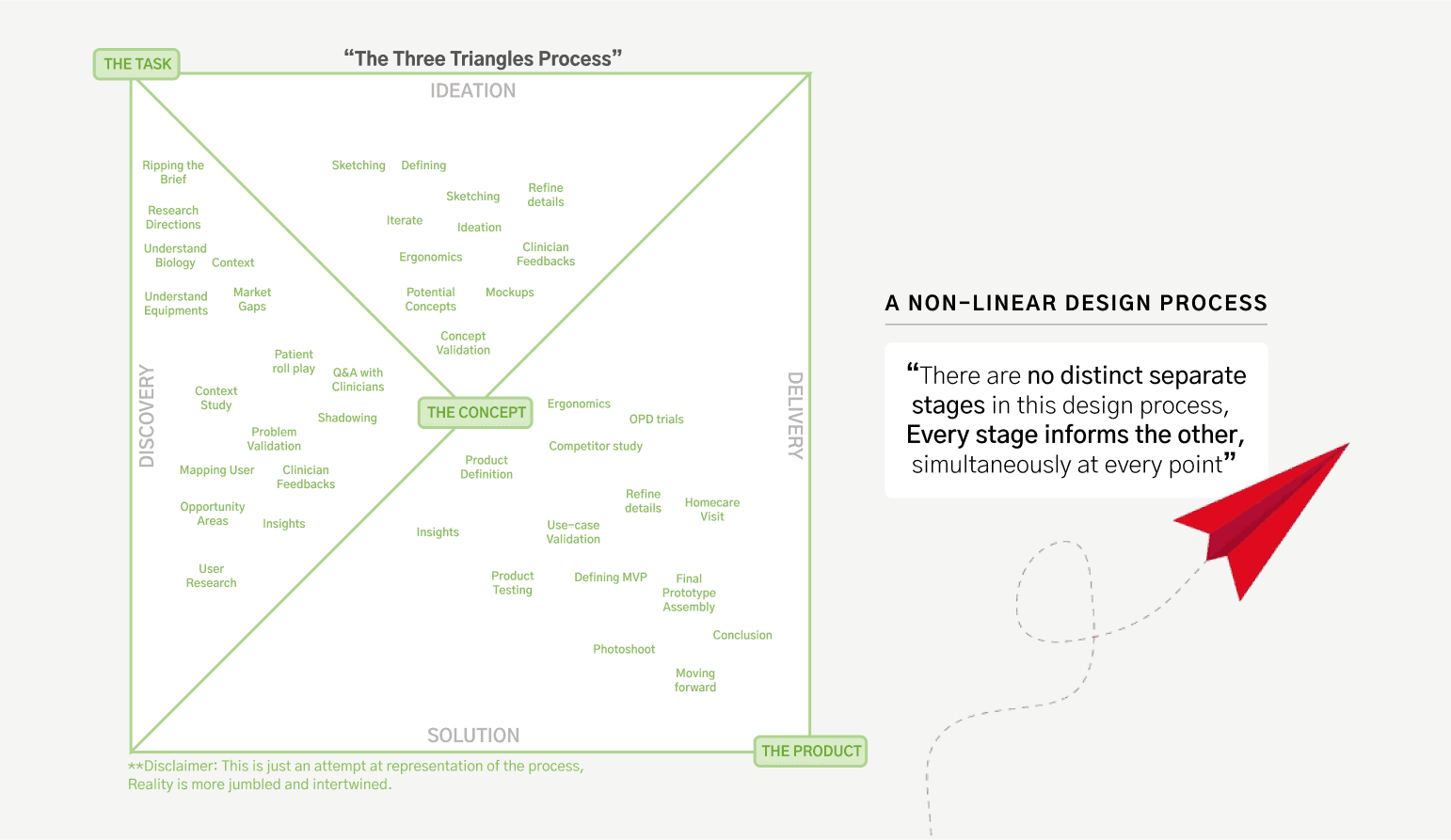
Disclaimer: This is just an attempt at representation of the process, Reality is more jumbled and intertwined.
Research
Role Play: Experiencing Patient's Perspective
To deepen my understanding of the patient experience, I underwent a complete eye examination—including IOP checks, slit-lamp, and undilated fundus exams. This first-hand exposure gave me insights no focus group or brainstorming session could match. Experiencing procedures as a patient, guided sincerely by optometrist Mr. Prasanna Vinod Murti, helped me absorb contextual, emotional, and spatial cues critical to HawkEye’s design. Roleplaying, I found, is a powerful tool in human-centered research—one that brings spontaneous, unfiltered insights to the surface.
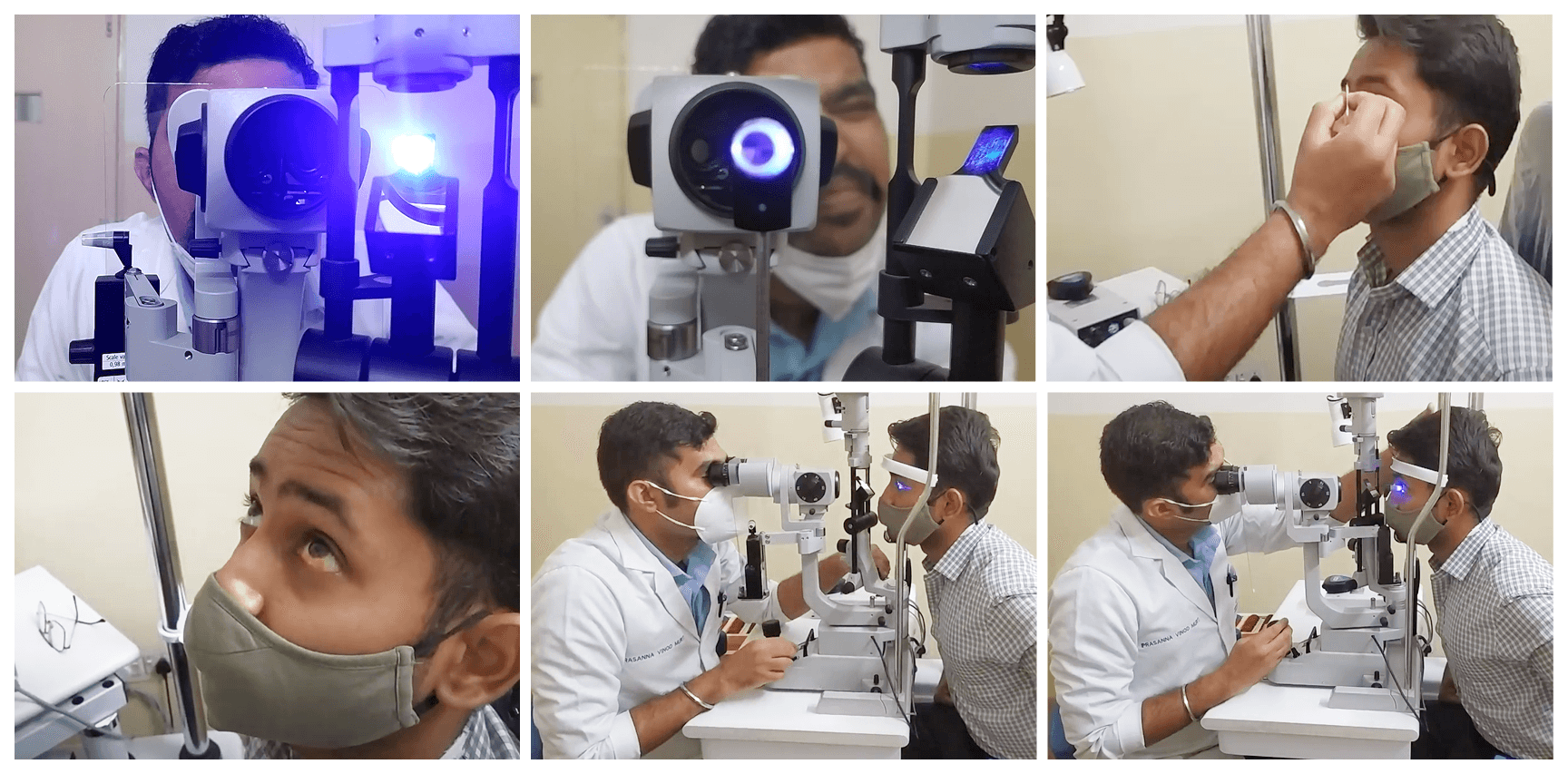
Experiencing tonometry, slit-lamp examination and other procedures part of a comprehensive examination
Research
Competitor Study: Learning from What Exists
“You only feel the flaws of a tool when you hold it like the user does.”
To design HawkEye with empathy and precision, I studied existing portable ophthalmic devices in real-world settings. Using Remidio’s Portable Slit Lamp revealed the power of compact engineering and AI-assisted imaging. In contrast, the Keeler PSL Classic, though functional, presented ergonomic and usability challenges—its weight, fixed focus, and proximity requirements caused discomfort and strain. I also explored applanation tonometers, where despite the ongoing debate, LVPEI clinicians favored the Goldmann model, which was ultimately integrated into HawkEye and validated through IRB testing. These immersive comparisons brought clarity to what works, what doesn’t, and what must evolve—for the clinician and the patient.

Experiencing tonometry, slit-lamp examination and other procedures part of a comprehensive examination

Hands-on exploration to understand the PSL’s learning curve, ergonomics, and functional nuances from a user’s perspective.
Synthesis & Framing
Turning Observations Into Opportunity: The UX Synthesis Phase
“Design didn’t begin with ideas — it began with noticing. With absorbing silences, tensions, and frictions that others had normalized.”
Before diving into form or function, I needed to frame the problem through the lens of people. After weeks of shadowing clinicians, observing patient behavior, and roleplaying as a patient myself, I began synthesizing the invisible patterns — what caused hesitation, where strain accumulated, what confused or comforted. These weren’t just usability issues. They were emotional cues.
I mapped recurring pain points like fatigue from prolonged equipment use, inconsistent postures during diagnosis, confusing LED cues, and the anxiety patients felt when confronted with unfamiliar tools. I also outlined the distinct use-case scenarios HawkEye would serve — from home-visit screenings and mobile vans to vision centers and low-infra clinics.
From this, I defined five core design mandates that became my north star: (1) one-handed ergonomic comfort, (2) visual balance for accurate phone-based imaging, (3) intuitive swappability of modules, (4) low learning curve for minimally trained technicians, and (5) durability for dust, humidity, and sanitization in rural conditions.
These priorities were not theoretical. They were derived directly from field context and grounded in real-world limitations. This synthesis process laid the foundation for every sketch, prototype, and engineering choice that followed.
Ref: (Complete case study) Pg. 50–53, 60

I've always wanted to design a product that would ultimately help India's masses as an Industrial Designer.
Form Development
Prototyping With Purpose:
From Clay to CAD to Nylon: Iterating the Invisible
“The device had to feel intuitive even to someone holding it for the first time. That’s not found in a CAD model — it’s shaped by hands, over time.”
I created dozens of iterations for the handle and control head — including 3D-printed versions with custom seam placements, ergonomic tests across multiple hand sizes, and finally plastic-engineered versions with MJF Nylon for durability and sanitization.
I followed a deeply non-linear, feedback-driven prototyping process, with each iteration shaped by real-world testing and clinician feedback. From paper to nylon, each form was crafted not just for how it looked — but for how it was used.
The core goals during prototyping were:
Ergonomic stability for long-duration use
Seamless modularity (with magnetic feedback)
Intuitive hand feel, reachability of controls
Field-serviceable design for low-resource clinics
Compatibility with phone-based imaging

Sketching everyday during the design process is like bread & butter. Inking stagnant ideas promotes better ideation.


A picture to wrap up control-head and handle cross-section explorations. The amount of explorations depends on the amount of time available. However, one can also reach a closure if the explorations meet the engineering and design requirements.


After countless explorations, a functional seam that gives access to the assembly of controls.

Engineering the Design;
The contol-head bears the seam and gives an unrestricted access to the internal. However, the access to battery/cell and it’s charging chip was given in the bottom for obvious reasons

Slots and details:
Details of the control head. One of my first explorations of design and engineerig at this level.

Charging Port Access;
Bottom access; to assemble the Adafruit charge-booster and the cells of HawkEye.
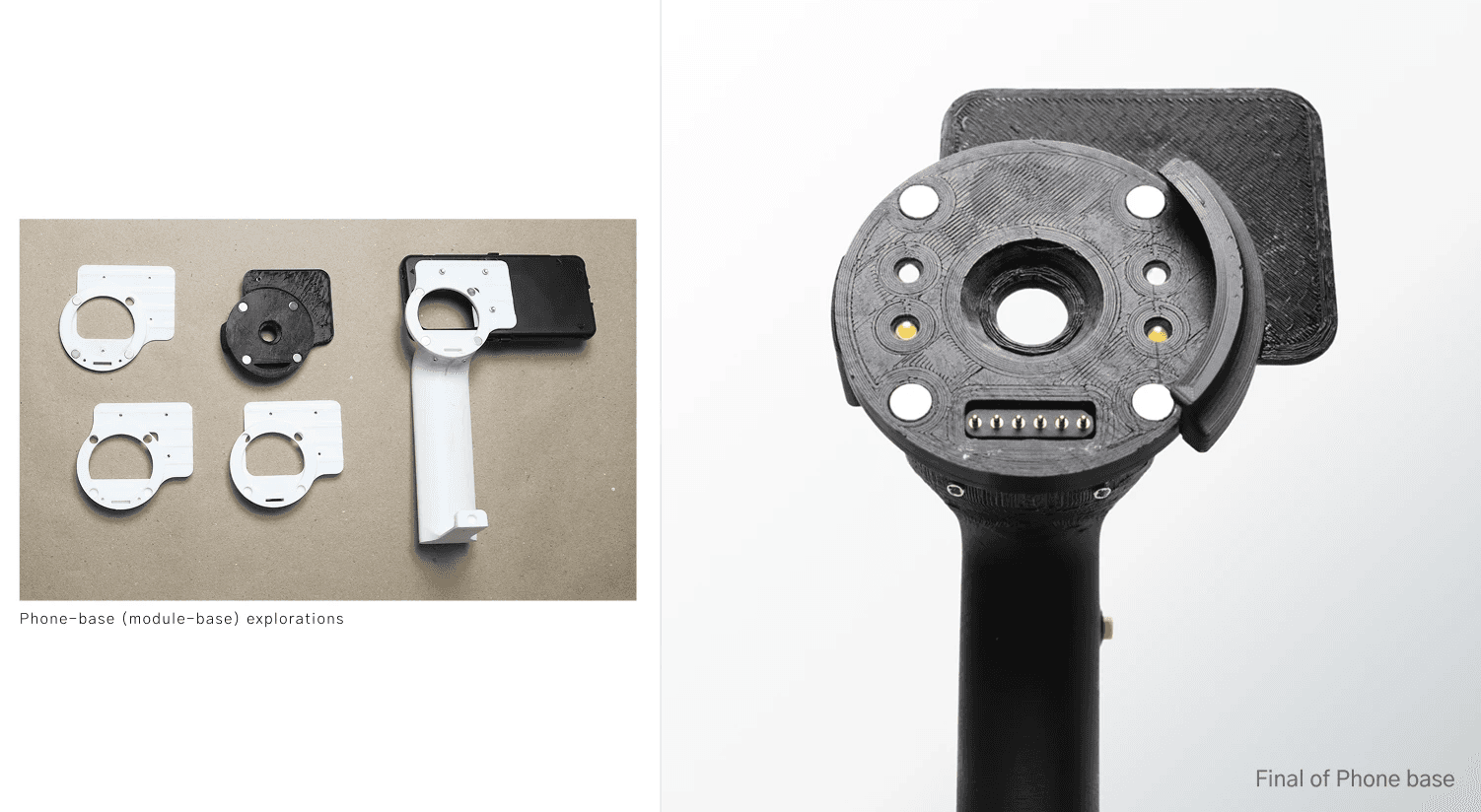
Evolustion of Phone base;

ASI module developement
The modules were already engineered and functioned excellently.
However, the head rest, user experience, minor details(Knobs, smoothness, etc) were not addressed.

Headrest explorations;
Different kinds of headrest extention styles were explored and tested.
ASI module proved to work better with a spring based extension.
Tonometer module proved to work better with a more stable, screw based extention system

Validation after each improvement;
Testing and improving headrest systems was very intense. Headrest plays a major role in the results of the image produced.
Therefore, a lot of time was dedicated nd spent on fine tuning it.

ASI module developement;


Tonometer Module Developement;
Tonometer requires blue light illumination for it’s functioning. It was a challenge to design and engineer a seamless detail that would solve the requirement.
These sketches are explorations of the same.


Evolution/iterations of Tonometer module;

Sketched exploring stability/docking position of HawkEye;
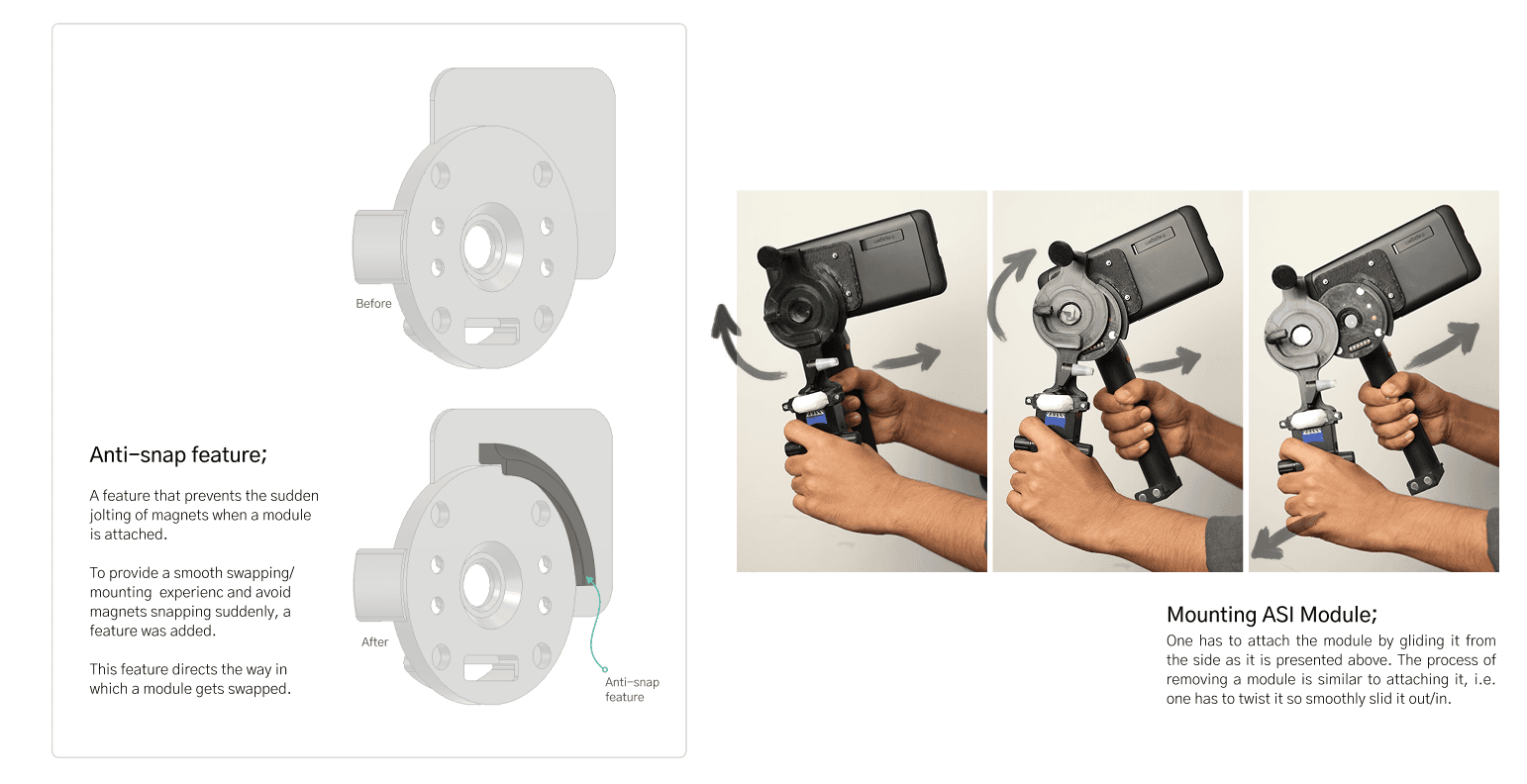

Mounting ASI Module;
One had to attach the module by gliding it from the side as it is presented above. The process of removing a module is similar to attaching it, i.e. one has to twist it so smoothly slid it out.

Assembly was mostly done using screws. Glue was used on rare occasions
Testing & Iterating
In-Clinic Testing + Feedback Loops
I brought every prototype back to LVPEI’s clinic.
Over 55+ iterative testing rounds, clinicians used the device on real patients and provided immediate feedback. Common adjustments:
Chin rest spring vs. screw tension
Button placement and feedback feel
Module mounting pressure and orientation
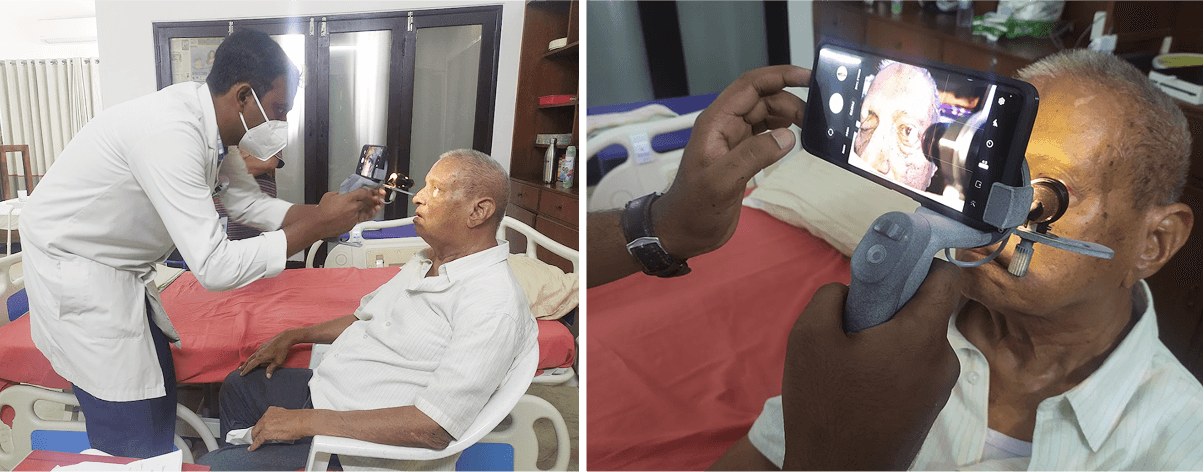
Home Eyecare Visit;
Testing a MJF 3D printed HawkEye SE during a homecare visit (Operation Suitcase)
This visit gave me insights on a bed ridden patient’s situation. And also observed the procedure of eye examination at home.

Discussing with engineers Bio-NEST, LVPEI, about manufacturing, materials, healthcare regulatory standards, deployment and more.
Delivery & Results
Final Modular Product Delivery
The modular system was finalized into two versions:
HawkEye SE: Simple, non-modular
HawkEye Modular: With Slit Lamp & Tonometer modules, phone dock, stable base, and ready for deployment
Both versions were clinically validated and packaged for Operation Suitcase use.


HAWKEYE SE SIMPLE EDITION (NON MODULAR)

HAWKEYE MODULAR
HawkEye Modular version with tonometer module mounted

Tonometer module close-up

HawkEye Modular version with Slit Lamp module mounted

HawkEye Slit Lamp module details
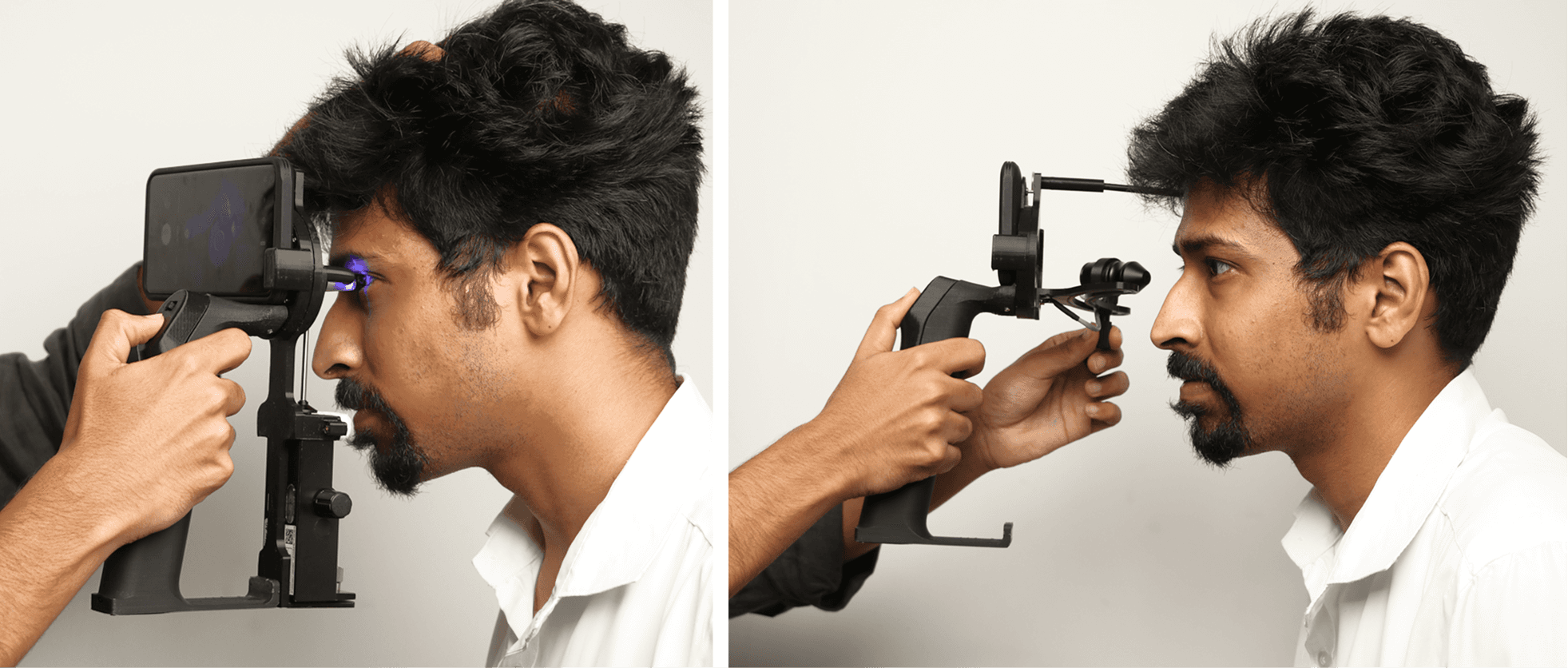
HawkEye Modular version with tonometer module mounted;
HawkEye Modular version with ASI module mounted.

SAMPLES: ASI (NO MODULE)

SAMPLES: SLIT LAMP MODULE

SAMPLES: TONOMETER MODULE
Looking back
What This Project Taught Me About Design — and Myself
“Designing HawkEye wasn’t just about solving a problem. It was about seeing the world differently — through the eyes of patients, clinicians, and systems.”
Working on HawkEye has been one of the most intense and transformative journeys of my design career. It challenged me to connect clinical rigor with human emotion, to balance engineering constraints with intuitive usability, and to navigate ambiguity with empathy. It taught me that even a few millimetres — a button's depth, a grip’s curve — can dramatically alter how a product lives in someone’s hands.
At CFTI, LVPEI, I was immersed in a living lab of innovation. I didn’t just work on my own project — I contributed to a variety of ongoing medical design initiatives, learned about IP and compliance, observed real diagnostics, and built meaningful collaborations with doctors, engineers, and technicians. I developed the confidence to speak the language of medicine, to ask better questions, and to design with clarity and responsibility.
What began as an industrial design challenge evolved into something much deeper: a human-centered mission to build accessible, affordable, and deployable healthcare tools for India — and perhaps the world. I had the rare privilege of seeing my prototype used on real patients. That moment — watching someone blink under a tool I had built — was worth every iteration, late night, and revision.
This project has shaped how I see design itself. As a tool for healing, for equality, for presence. Whether or not I stay in the medical field, I will always carry these learnings forward — into whatever product, platform, or place I design next.
HawkEye has taught me to see. And for a designer, there is no greater gift.


So that all may see.
Research
Competitor Study: Learning from What Exists
“You only feel the flaws of a tool when you hold it like the user does.”
To design HawkEye with empathy and precision, I studied existing portable ophthalmic devices in real-world settings. Using Remidio’s Portable Slit Lamp revealed the power of compact engineering and AI-assisted imaging. In contrast, the Keeler PSL Classic, though functional, presented ergonomic and usability challenges—its weight, fixed focus, and proximity requirements caused discomfort and strain. I also explored applanation tonometers, where despite the ongoing debate, LVPEI clinicians favored the Goldmann model, which was ultimately integrated into HawkEye and validated through IRB testing. These immersive comparisons brought clarity to what works, what doesn’t, and what must evolve—for the clinician and the patient.
Experiencing tonometry, slit-lamp examination and other procedures part of a comprehensive examination
Hands-on exploration to understand the PSL’s learning curve, ergonomics, and functional nuances from a user’s perspective.
Synthesis & Framing
Turning Observations Into Opportunity: The UX Synthesis Phase
“Design didn’t begin with ideas — it began with noticing. With absorbing silences, tensions, and frictions that others had normalized.”
Before diving into form or function, I needed to frame the problem through the lens of people. After weeks of shadowing clinicians, observing patient behavior, and roleplaying as a patient myself, I began synthesizing the invisible patterns — what caused hesitation, where strain accumulated, what confused or comforted. These weren’t just usability issues. They were emotional cues.
I mapped recurring pain points like fatigue from prolonged equipment use, inconsistent postures during diagnosis, confusing LED cues, and the anxiety patients felt when confronted with unfamiliar tools. I also outlined the distinct use-case scenarios HawkEye would serve — from home-visit screenings and mobile vans to vision centers and low-infra clinics.
From this, I defined five core design mandates that became my north star: (1) one-handed ergonomic comfort, (2) visual balance for accurate phone-based imaging, (3) intuitive swappability of modules, (4) low learning curve for minimally trained technicians, and (5) durability for dust, humidity, and sanitization in rural conditions.
These priorities were not theoretical. They were derived directly from field context and grounded in real-world limitations. This synthesis process laid the foundation for every sketch, prototype, and engineering choice that followed.
Ref: (Complete case study) Pg. 50–53, 60
I've always wanted to design a product that would ultimately help India's masses as an Industrial Designer.
Form Development
Prototyping With Purpose:
From Clay to CAD to Nylon: Iterating the Invisible
“The device had to feel intuitive even to someone holding it for the first time. That’s not found in a CAD model — it’s shaped by hands, over time.”
I created dozens of iterations for the handle and control head — including 3D-printed versions with custom seam placements, ergonomic tests across multiple hand sizes, and finally plastic-engineered versions with MJF Nylon for durability and sanitization.
I followed a deeply non-linear, feedback-driven prototyping process, with each iteration shaped by real-world testing and clinician feedback. From paper to nylon, each form was crafted not just for how it looked — but for how it was used.
The core goals during prototyping were:
Ergonomic stability for long-duration use
Seamless modularity (with magnetic feedback)
Intuitive hand feel, reachability of controls
Field-serviceable design for low-resource clinics
Compatibility with phone-based imaging
Sketching everyday during the design process is like bread & butter. Inking stagnant ideas promotes better ideation.
A picture to wrap up control-head and handle cross-section explorations. The amount of explorations depends on the amount of time available. However, one can also reach a closure if the explorations meet the engineering and design requirements.
After countless explorations, a functional seam that gives access to the assembly of controls.
Engineering the Design;
The contol-head bears the seam and gives an unrestricted access to the internal. However, the access to battery/cell and it’s charging chip was given in the bottom for obvious reasons
Slots and details:
Details of the control head. One of my first explorations of design and engineerig at this level.
Charging Port Access;
Bottom access; to assemble the Adafruit charge-booster and the cells of HawkEye.
Evolustion of Phone base;
ASI module developement
The modules were already engineered and functioned excellently.
However, the head rest, user experience, minor details(Knobs, smoothness, etc) were not addressed.
Headrest explorations;
Different kinds of headrest extention styles were explored and tested.
ASI module proved to work better with a spring based extension.
Tonometer module proved to work better with a more stable, screw based extention system
Validation after each improvement;
Testing and improving headrest systems was very intense. Headrest plays a major role in the results of the image produced.
Therefore, a lot of time was dedicated nd spent on fine tuning it.
ASI module developement;
Tonometer Module Developement;
Tonometer requires blue light illumination for it’s functioning. It was a challenge to design and engineer a seamless detail that would solve the requirement.
These sketches are explorations of the same.
Evolution/iterations of Tonometer module;
Sketched exploring stability/docking position of HawkEye;
Mounting ASI Module;
One had to attach the module by gliding it from the side as it is presented above. The process of removing a module is similar to attaching it, i.e. one has to twist it so smoothly slid it out.
Assembly was mostly done using screws. Glue was used on rare occasions
Testing & Iterating
In-Clinic Testing + Feedback Loops
I brought every prototype back to LVPEI’s clinic.
Over 55+ iterative testing rounds, clinicians used the device on real patients and provided immediate feedback. Common adjustments:
Chin rest spring vs. screw tension
Button placement and feedback feel
Module mounting pressure and orientation
Home Eyecare Visit;
Testing a MJF 3D printed HawkEye SE during a homecare visit (Operation Suitcase)
This visit gave me insights on a bed ridden patient’s situation. And also observed the procedure of eye examination at home.
Discussing with engineers Bio-NEST, LVPEI, about manufacturing, materials, healthcare regulatory standards, deployment and more.
Delivery & Results
Final Modular Product Delivery
The modular system was finalized into two versions:
HawkEye SE: Simple, non-modular
HawkEye Modular: With Slit Lamp & Tonometer modules, phone dock, stable base, and ready for deployment
Both versions were clinically validated and packaged for Operation Suitcase use.
HAWKEYE SE SIMPLE EDITION (NON MODULAR)
HAWKEYE MODULAR
HawkEye Modular version with tonometer module mounted
Tonometer module close-up
HawkEye Modular version with Slit Lamp module mounted
HawkEye Slit Lamp module details
HawkEye Modular version with tonometer module mounted;
HawkEye Modular version with ASI module mounted.
SAMPLES: ASI (NO MODULE)
SAMPLES: SLIT LAMP MODULE
SAMPLES: TONOMETER MODULE
Looking back
What This Project Taught Me About Design — and Myself
“Designing HawkEye wasn’t just about solving a problem. It was about seeing the world differently — through the eyes of patients, clinicians, and systems.”
Working on HawkEye has been one of the most intense and transformative journeys of my design career. It challenged me to connect clinical rigor with human emotion, to balance engineering constraints with intuitive usability, and to navigate ambiguity with empathy. It taught me that even a few millimetres — a button's depth, a grip’s curve — can dramatically alter how a product lives in someone’s hands.
At CFTI, LVPEI, I was immersed in a living lab of innovation. I didn’t just work on my own project — I contributed to a variety of ongoing medical design initiatives, learned about IP and compliance, observed real diagnostics, and built meaningful collaborations with doctors, engineers, and technicians. I developed the confidence to speak the language of medicine, to ask better questions, and to design with clarity and responsibility.
What began as an industrial design challenge evolved into something much deeper: a human-centered mission to build accessible, affordable, and deployable healthcare tools for India — and perhaps the world. I had the rare privilege of seeing my prototype used on real patients. That moment — watching someone blink under a tool I had built — was worth every iteration, late night, and revision.
This project has shaped how I see design itself. As a tool for healing, for equality, for presence. Whether or not I stay in the medical field, I will always carry these learnings forward — into whatever product, platform, or place I design next.
HawkEye has taught me to see. And for a designer, there is no greater gift.
So that all may see.
Concept
“We’ve always wanted to go to the patient. HawkEye lets us carry the clinic in our hand.”
— Optometrist, LVPEI
Over 75% of visual impairment is avoidable. Yet, millions lack access to quality eye care due to bulky equipment, geographical barriers, and high costs. HawkEye is a phone-integrated, modular ophthalmic screening device that delivers slit-lamp imaging, tonometry, fundus capture, and corneal topography — in a compact, affordable form. Designed with clinicians, tested with real patients, and validated under IRB trials, HawkEye is a rare confluence of medical, industrial, and human-centered design.
A human-centered redesign of ophthalmic diagnostics — making comprehensive eye exams accessible, mobile, and modular.
Brief
Redesigning Eye Care for All: From Clinics to the Community
HawkEye is a modular, smartphone-powered ophthalmic screening device that condenses the functionality of four essential eye exam tools into one portable system. Designed for LVPEI’s mobile and rural initiatives, the device addresses India’s pressing need for affordable, scalable vision diagnostics.
“This wasn’t just about design. It was about dignity, access, and trust — where patients are.”
— Harshavardhan M V
Why Eye Health
The Case for Vision Access
While advanced hospitals serve the affluent, the rural population is left behind. Traditional ophthalmic tools are bulky, stationary, and prohibitively expensive — widening the care gap. LVPEI’s Operation Suitcase project sought a leap: affordable, field-ready diagnostics in one compact device.
“Most blindness isn’t fate — it’s access.”
Lack of access due to high cost and geography.
India has 15 million visually impaired; 75% of blindness is avoidable.
Existing equipment is bulky, non-portable, expensive.
Problem
The Cost of Vision: Bulky Machines, Invisible Barriers
From slit lamps to tonometers, every essential device for eye care is large, costly, and built for clinics. Even when portable options exist, their pricing defeats accessibility. For community clinics, home visits, or low-budget hospitals, these tools are simply not viable.
“Even the portable devices were out of reach — we needed a complete rethink.”
— Optometrist Rahul Negi
Concept
One Handle. Many Eyes. The Modular Magic of HawkEye
“Modularity was the answer. If we could swap lenses, why not diagnostic tools?”
HawkEye compresses four critical diagnostic tools into one system. Using magnets, custom grips, and intelligent interfaces, modules can be seamlessly swapped while the smartphone captures diagnostic imagery. It's not just portable — it’s scalable, teachable, and ready for home care.
In the given timeline, as a lone designer, I could complete only 3 states of HawkEye. Fundus imager and Corneal topography are still WIP.
These three images are the three modes of HawkEye. Using these three modes, we are able to perform 4 types of screening tests.
Process
Research, Sketch, Iterate — Then Repeat
Over 6 months, I lived and breathed this process — sketching, prototyping, clay modeling, and validating. From camera-grip-inspired handles to VR-trigger buttons, I explored over 12 versions before the form finally clicked. Clinicians gave constant feedback. Patients helped validate comfort. Every seam was a story.
Disclaimer: This is just an attempt at representation of the process, Reality is more jumbled and intertwined.
Research
Role Play: Experiencing Patient's Perspective
To deepen my understanding of the patient experience, I underwent a complete eye examination—including IOP checks, slit-lamp, and undilated fundus exams. This first-hand exposure gave me insights no focus group or brainstorming session could match. Experiencing procedures as a patient, guided sincerely by optometrist Mr. Prasanna Vinod Murti, helped me absorb contextual, emotional, and spatial cues critical to HawkEye’s design. Roleplaying, I found, is a powerful tool in human-centered research—one that brings spontaneous, unfiltered insights to the surface.
Experiencing tonometry, slit-lamp examination and other procedures part of a comprehensive examination
Research
Competitor Study: Learning from What Exists
“You only feel the flaws of a tool when you hold it like the user does.”
To design HawkEye with empathy and precision, I studied existing portable ophthalmic devices in real-world settings. Using Remidio’s Portable Slit Lamp revealed the power of compact engineering and AI-assisted imaging. In contrast, the Keeler PSL Classic, though functional, presented ergonomic and usability challenges—its weight, fixed focus, and proximity requirements caused discomfort and strain. I also explored applanation tonometers, where despite the ongoing debate, LVPEI clinicians favored the Goldmann model, which was ultimately integrated into HawkEye and validated through IRB testing. These immersive comparisons brought clarity to what works, what doesn’t, and what must evolve—for the clinician and the patient.
Experiencing tonometry, slit-lamp examination and other procedures part of a comprehensive examination
Hands-on exploration to understand the PSL’s learning curve, ergonomics, and functional nuances from a user’s perspective.
Synthesis & Framing
Turning Observations Into Opportunity: The UX Synthesis Phase
“Design didn’t begin with ideas — it began with noticing. With absorbing silences, tensions, and frictions that others had normalized.”
Before diving into form or function, I needed to frame the problem through the lens of people. After weeks of shadowing clinicians, observing patient behavior, and roleplaying as a patient myself, I began synthesizing the invisible patterns — what caused hesitation, where strain accumulated, what confused or comforted. These weren’t just usability issues. They were emotional cues.
I mapped recurring pain points like fatigue from prolonged equipment use, inconsistent postures during diagnosis, confusing LED cues, and the anxiety patients felt when confronted with unfamiliar tools. I also outlined the distinct use-case scenarios HawkEye would serve — from home-visit screenings and mobile vans to vision centers and low-infra clinics.
From this, I defined five core design mandates that became my north star: (1) one-handed ergonomic comfort, (2) visual balance for accurate phone-based imaging, (3) intuitive swappability of modules, (4) low learning curve for minimally trained technicians, and (5) durability for dust, humidity, and sanitization in rural conditions.
These priorities were not theoretical. They were derived directly from field context and grounded in real-world limitations. This synthesis process laid the foundation for every sketch, prototype, and engineering choice that followed.
Ref: (Complete case study) Pg. 50–53, 60
I've always wanted to design a product that would ultimately help India's masses as an Industrial Designer.
Form Development
Prototyping With Purpose:
From Clay to CAD to Nylon: Iterating the Invisible
“The device had to feel intuitive even to someone holding it for the first time. That’s not found in a CAD model — it’s shaped by hands, over time.”
I created dozens of iterations for the handle and control head — including 3D-printed versions with custom seam placements, ergonomic tests across multiple hand sizes, and finally plastic-engineered versions with MJF Nylon for durability and sanitization.
I followed a deeply non-linear, feedback-driven prototyping process, with each iteration shaped by real-world testing and clinician feedback. From paper to nylon, each form was crafted not just for how it looked — but for how it was used.
The core goals during prototyping were:
Ergonomic stability for long-duration use
Seamless modularity (with magnetic feedback)
Intuitive hand feel, reachability of controls
Field-serviceable design for low-resource clinics
Compatibility with phone-based imaging
Sketching everyday during the design process is like bread & butter. Inking stagnant ideas promotes better ideation.
A picture to wrap up control-head and handle cross-section explorations. The amount of explorations depends on the amount of time available. However, one can also reach a closure if the explorations meet the engineering and design requirements.
After countless explorations, a functional seam that gives access to the assembly of controls.
Engineering the Design;
The contol-head bears the seam and gives an unrestricted access to the internal. However, the access to battery/cell and it’s charging chip was given in the bottom for obvious reasons
Slots and details:
Details of the control head. One of my first explorations of design and engineerig at this level.
Charging Port Access;
Bottom access; to assemble the Adafruit charge-booster and the cells of HawkEye.
Evolustion of Phone base;
ASI module developement
The modules were already engineered and functioned excellently.
However, the head rest, user experience, minor details(Knobs, smoothness, etc) were not addressed.
Headrest explorations;
Different kinds of headrest extention styles were explored and tested.
ASI module proved to work better with a spring based extension.
Tonometer module proved to work better with a more stable, screw based extention system
Validation after each improvement;
Testing and improving headrest systems was very intense. Headrest plays a major role in the results of the image produced.
Therefore, a lot of time was dedicated nd spent on fine tuning it.
ASI module developement;
Tonometer Module Developement;
Tonometer requires blue light illumination for it’s functioning. It was a challenge to design and engineer a seamless detail that would solve the requirement.
These sketches are explorations of the same.
Evolution/iterations of Tonometer module;
Sketched exploring stability/docking position of HawkEye;
Mounting ASI Module;
One had to attach the module by gliding it from the side as it is presented above. The process of removing a module is similar to attaching it, i.e. one has to twist it so smoothly slid it out.
Assembly was mostly done using screws. Glue was used on rare occasions
Testing & Iterating
In-Clinic Testing + Feedback Loops
I brought every prototype back to LVPEI’s clinic.
Over 55+ iterative testing rounds, clinicians used the device on real patients and provided immediate feedback. Common adjustments:
Chin rest spring vs. screw tension
Button placement and feedback feel
Module mounting pressure and orientation
Home Eyecare Visit;
Testing a MJF 3D printed HawkEye SE during a homecare visit (Operation Suitcase)
This visit gave me insights on a bed ridden patient’s situation. And also observed the procedure of eye examination at home.
Discussing with engineers Bio-NEST, LVPEI, about manufacturing, materials, healthcare regulatory standards, deployment and more.
Delivery & Results
Final Modular Product Delivery
The modular system was finalized into two versions:
HawkEye SE: Simple, non-modular
HawkEye Modular: With Slit Lamp & Tonometer modules, phone dock, stable base, and ready for deployment
Both versions were clinically validated and packaged for Operation Suitcase use.
HAWKEYE SE SIMPLE EDITION (NON MODULAR)
HAWKEYE MODULAR
HawkEye Modular version with tonometer module mounted
Tonometer module close-up
HawkEye Modular version with Slit Lamp module mounted
HawkEye Slit Lamp module details
HawkEye Modular version with tonometer module mounted;
HawkEye Modular version with ASI module mounted.
SAMPLES: ASI (NO MODULE)
SAMPLES: SLIT LAMP MODULE
SAMPLES: TONOMETER MODULE
Looking back
What This Project Taught Me About Design — and Myself
“Designing HawkEye wasn’t just about solving a problem. It was about seeing the world differently — through the eyes of patients, clinicians, and systems.”
Working on HawkEye has been one of the most intense and transformative journeys of my design career. It challenged me to connect clinical rigor with human emotion, to balance engineering constraints with intuitive usability, and to navigate ambiguity with empathy. It taught me that even a few millimetres — a button's depth, a grip’s curve — can dramatically alter how a product lives in someone’s hands.
At CFTI, LVPEI, I was immersed in a living lab of innovation. I didn’t just work on my own project — I contributed to a variety of ongoing medical design initiatives, learned about IP and compliance, observed real diagnostics, and built meaningful collaborations with doctors, engineers, and technicians. I developed the confidence to speak the language of medicine, to ask better questions, and to design with clarity and responsibility.
What began as an industrial design challenge evolved into something much deeper: a human-centered mission to build accessible, affordable, and deployable healthcare tools for India — and perhaps the world. I had the rare privilege of seeing my prototype used on real patients. That moment — watching someone blink under a tool I had built — was worth every iteration, late night, and revision.
This project has shaped how I see design itself. As a tool for healing, for equality, for presence. Whether or not I stay in the medical field, I will always carry these learnings forward — into whatever product, platform, or place I design next.
HawkEye has taught me to see. And for a designer, there is no greater gift.
So that all may see.
Concept
“We’ve always wanted to go to the patient. HawkEye lets us carry the clinic in our hand.”
— Optometrist, LVPEI
Over 75% of visual impairment is avoidable. Yet, millions lack access to quality eye care due to bulky equipment, geographical barriers, and high costs. HawkEye is a phone-integrated, modular ophthalmic screening device that delivers slit-lamp imaging, tonometry, fundus capture, and corneal topography — in a compact, affordable form. Designed with clinicians, tested with real patients, and validated under IRB trials, HawkEye is a rare confluence of medical, industrial, and human-centered design.
A human-centered redesign of ophthalmic diagnostics — making comprehensive eye exams accessible, mobile, and modular.
Brief
Redesigning Eye Care for All: From Clinics to the Community
HawkEye is a modular, smartphone-powered ophthalmic screening device that condenses the functionality of four essential eye exam tools into one portable system. Designed for LVPEI’s mobile and rural initiatives, the device addresses India’s pressing need for affordable, scalable vision diagnostics.
“This wasn’t just about design. It was about dignity, access, and trust — where patients are.”
— Harshavardhan M V
Why Eye Health
The Case for Vision Access
While advanced hospitals serve the affluent, the rural population is left behind. Traditional ophthalmic tools are bulky, stationary, and prohibitively expensive — widening the care gap. LVPEI’s Operation Suitcase project sought a leap: affordable, field-ready diagnostics in one compact device.
“Most blindness isn’t fate — it’s access.”
Lack of access due to high cost and geography.
India has 15 million visually impaired; 75% of blindness is avoidable.
Existing equipment is bulky, non-portable, expensive.
Problem
The Cost of Vision: Bulky Machines, Invisible Barriers
From slit lamps to tonometers, every essential device for eye care is large, costly, and built for clinics. Even when portable options exist, their pricing defeats accessibility. For community clinics, home visits, or low-budget hospitals, these tools are simply not viable.
“Even the portable devices were out of reach — we needed a complete rethink.”
— Optometrist Rahul Negi
Concept
One Handle. Many Eyes. The Modular Magic of HawkEye
“Modularity was the answer. If we could swap lenses, why not diagnostic tools?”
HawkEye compresses four critical diagnostic tools into one system. Using magnets, custom grips, and intelligent interfaces, modules can be seamlessly swapped while the smartphone captures diagnostic imagery. It's not just portable — it’s scalable, teachable, and ready for home care.
In the given timeline, as a lone designer, I could complete only 3 states of HawkEye. Fundus imager and Corneal topography are still WIP.
These three images are the three modes of HawkEye. Using these three modes, we are able to perform 4 types of screening tests.
Process
Research, Sketch, Iterate — Then Repeat
Over 6 months, I lived and breathed this process — sketching, prototyping, clay modeling, and validating. From camera-grip-inspired handles to VR-trigger buttons, I explored over 12 versions before the form finally clicked. Clinicians gave constant feedback. Patients helped validate comfort. Every seam was a story.
Disclaimer: This is just an attempt at representation of the process, Reality is more jumbled and intertwined.
Research
Role Play: Experiencing Patient's Perspective
To deepen my understanding of the patient experience, I underwent a complete eye examination—including IOP checks, slit-lamp, and undilated fundus exams. This first-hand exposure gave me insights no focus group or brainstorming session could match. Experiencing procedures as a patient, guided sincerely by optometrist Mr. Prasanna Vinod Murti, helped me absorb contextual, emotional, and spatial cues critical to HawkEye’s design. Roleplaying, I found, is a powerful tool in human-centered research—one that brings spontaneous, unfiltered insights to the surface.
Experiencing tonometry, slit-lamp examination and other procedures part of a comprehensive examination
Research
Competitor Study: Learning from What Exists
“You only feel the flaws of a tool when you hold it like the user does.”
To design HawkEye with empathy and precision, I studied existing portable ophthalmic devices in real-world settings. Using Remidio’s Portable Slit Lamp revealed the power of compact engineering and AI-assisted imaging. In contrast, the Keeler PSL Classic, though functional, presented ergonomic and usability challenges—its weight, fixed focus, and proximity requirements caused discomfort and strain. I also explored applanation tonometers, where despite the ongoing debate, LVPEI clinicians favored the Goldmann model, which was ultimately integrated into HawkEye and validated through IRB testing. These immersive comparisons brought clarity to what works, what doesn’t, and what must evolve—for the clinician and the patient.
Experiencing tonometry, slit-lamp examination and other procedures part of a comprehensive examination
Hands-on exploration to understand the PSL’s learning curve, ergonomics, and functional nuances from a user’s perspective.
Synthesis & Framing
Turning Observations Into Opportunity: The UX Synthesis Phase
“Design didn’t begin with ideas — it began with noticing. With absorbing silences, tensions, and frictions that others had normalized.”
Before diving into form or function, I needed to frame the problem through the lens of people. After weeks of shadowing clinicians, observing patient behavior, and roleplaying as a patient myself, I began synthesizing the invisible patterns — what caused hesitation, where strain accumulated, what confused or comforted. These weren’t just usability issues. They were emotional cues.
I mapped recurring pain points like fatigue from prolonged equipment use, inconsistent postures during diagnosis, confusing LED cues, and the anxiety patients felt when confronted with unfamiliar tools. I also outlined the distinct use-case scenarios HawkEye would serve — from home-visit screenings and mobile vans to vision centers and low-infra clinics.
From this, I defined five core design mandates that became my north star: (1) one-handed ergonomic comfort, (2) visual balance for accurate phone-based imaging, (3) intuitive swappability of modules, (4) low learning curve for minimally trained technicians, and (5) durability for dust, humidity, and sanitization in rural conditions.
These priorities were not theoretical. They were derived directly from field context and grounded in real-world limitations. This synthesis process laid the foundation for every sketch, prototype, and engineering choice that followed.
Ref: (Complete case study) Pg. 50–53, 60
I've always wanted to design a product that would ultimately help India's masses as an Industrial Designer.
Form Development
Prototyping With Purpose:
From Clay to CAD to Nylon: Iterating the Invisible
“The device had to feel intuitive even to someone holding it for the first time. That’s not found in a CAD model — it’s shaped by hands, over time.”
I created dozens of iterations for the handle and control head — including 3D-printed versions with custom seam placements, ergonomic tests across multiple hand sizes, and finally plastic-engineered versions with MJF Nylon for durability and sanitization.
I followed a deeply non-linear, feedback-driven prototyping process, with each iteration shaped by real-world testing and clinician feedback. From paper to nylon, each form was crafted not just for how it looked — but for how it was used.
The core goals during prototyping were:
Ergonomic stability for long-duration use
Seamless modularity (with magnetic feedback)
Intuitive hand feel, reachability of controls
Field-serviceable design for low-resource clinics
Compatibility with phone-based imaging
Sketching everyday during the design process is like bread & butter. Inking stagnant ideas promotes better ideation.
A picture to wrap up control-head and handle cross-section explorations. The amount of explorations depends on the amount of time available. However, one can also reach a closure if the explorations meet the engineering and design requirements.
After countless explorations, a functional seam that gives access to the assembly of controls.
Engineering the Design;
The contol-head bears the seam and gives an unrestricted access to the internal. However, the access to battery/cell and it’s charging chip was given in the bottom for obvious reasons
Slots and details:
Details of the control head. One of my first explorations of design and engineerig at this level.
Charging Port Access;
Bottom access; to assemble the Adafruit charge-booster and the cells of HawkEye.
Evolustion of Phone base;
ASI module developement
The modules were already engineered and functioned excellently.
However, the head rest, user experience, minor details(Knobs, smoothness, etc) were not addressed.
Headrest explorations;
Different kinds of headrest extention styles were explored and tested.
ASI module proved to work better with a spring based extension.
Tonometer module proved to work better with a more stable, screw based extention system
Validation after each improvement;
Testing and improving headrest systems was very intense. Headrest plays a major role in the results of the image produced.
Therefore, a lot of time was dedicated nd spent on fine tuning it.
ASI module developement;
Tonometer Module Developement;
Tonometer requires blue light illumination for it’s functioning. It was a challenge to design and engineer a seamless detail that would solve the requirement.
These sketches are explorations of the same.
Evolution/iterations of Tonometer module;
Sketched exploring stability/docking position of HawkEye;
Mounting ASI Module;
One had to attach the module by gliding it from the side as it is presented above. The process of removing a module is similar to attaching it, i.e. one has to twist it so smoothly slid it out.
Assembly was mostly done using screws. Glue was used on rare occasions
Testing & Iterating
In-Clinic Testing + Feedback Loops
I brought every prototype back to LVPEI’s clinic.
Over 55+ iterative testing rounds, clinicians used the device on real patients and provided immediate feedback. Common adjustments:
Chin rest spring vs. screw tension
Button placement and feedback feel
Module mounting pressure and orientation
Home Eyecare Visit;
Testing a MJF 3D printed HawkEye SE during a homecare visit (Operation Suitcase)
This visit gave me insights on a bed ridden patient’s situation. And also observed the procedure of eye examination at home.
Discussing with engineers Bio-NEST, LVPEI, about manufacturing, materials, healthcare regulatory standards, deployment and more.
Delivery & Results
Final Modular Product Delivery
The modular system was finalized into two versions:
HawkEye SE: Simple, non-modular
HawkEye Modular: With Slit Lamp & Tonometer modules, phone dock, stable base, and ready for deployment
Both versions were clinically validated and packaged for Operation Suitcase use.
HAWKEYE SE SIMPLE EDITION (NON MODULAR)
HAWKEYE MODULAR
HawkEye Modular version with tonometer module mounted
Tonometer module close-up
HawkEye Modular version with Slit Lamp module mounted
HawkEye Slit Lamp module details
HawkEye Modular version with tonometer module mounted;
HawkEye Modular version with ASI module mounted.
SAMPLES: ASI (NO MODULE)
SAMPLES: SLIT LAMP MODULE
SAMPLES: TONOMETER MODULE
Looking back
What This Project Taught Me About Design — and Myself
“Designing HawkEye wasn’t just about solving a problem. It was about seeing the world differently — through the eyes of patients, clinicians, and systems.”
Working on HawkEye has been one of the most intense and transformative journeys of my design career. It challenged me to connect clinical rigor with human emotion, to balance engineering constraints with intuitive usability, and to navigate ambiguity with empathy. It taught me that even a few millimetres — a button's depth, a grip’s curve — can dramatically alter how a product lives in someone’s hands.
At CFTI, LVPEI, I was immersed in a living lab of innovation. I didn’t just work on my own project — I contributed to a variety of ongoing medical design initiatives, learned about IP and compliance, observed real diagnostics, and built meaningful collaborations with doctors, engineers, and technicians. I developed the confidence to speak the language of medicine, to ask better questions, and to design with clarity and responsibility.
What began as an industrial design challenge evolved into something much deeper: a human-centered mission to build accessible, affordable, and deployable healthcare tools for India — and perhaps the world. I had the rare privilege of seeing my prototype used on real patients. That moment — watching someone blink under a tool I had built — was worth every iteration, late night, and revision.
This project has shaped how I see design itself. As a tool for healing, for equality, for presence. Whether or not I stay in the medical field, I will always carry these learnings forward — into whatever product, platform, or place I design next.
HawkEye has taught me to see. And for a designer, there is no greater gift.
So that all may see.